A salary account can look like just another account number. But a regular Sinopac salary account and a DAWHO digital salary account get their benefits from different rulebooks. This note compares the official pages: what differs, what does not, and what to ask HR first.
SinopacDAWHO薪轉戶Salary Account數位帳戶Digital Banking
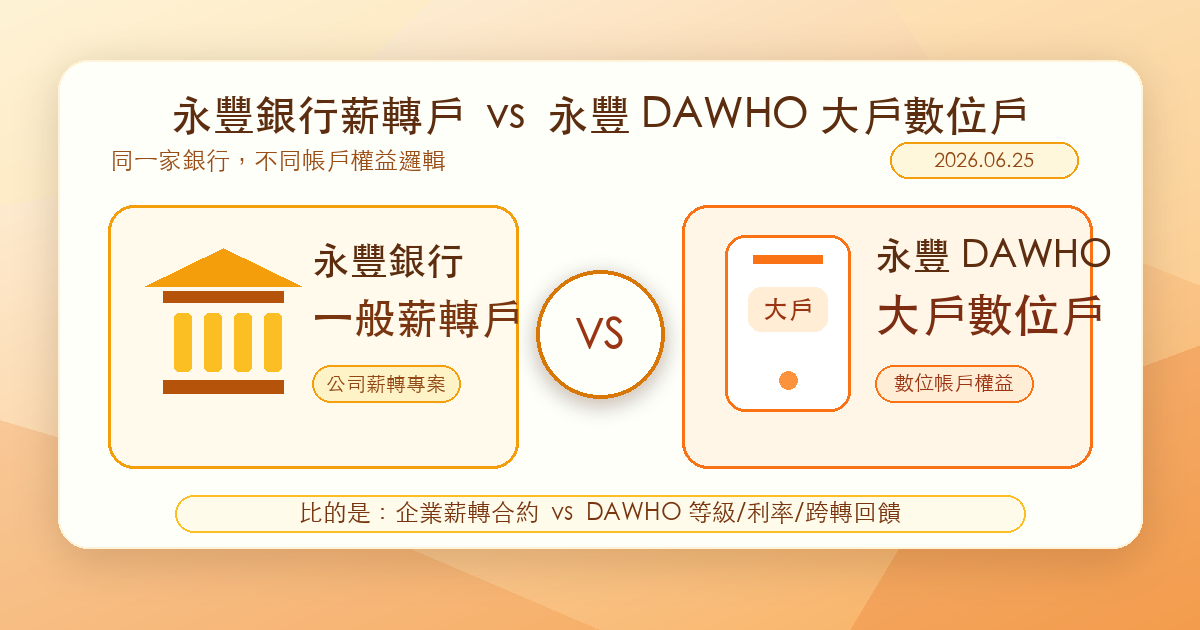
同一家銀行,不同權益邏輯:左邊是永豐銀行一般薪轉戶,右邊是永豐 DAWHO 大戶數位戶。Same bank, different benefit logic: one depends on the employer salary package; the other on DAWHO tiers and campaign rules.
A Sinopac salary account and a DAWHO salary account both sit under Bank SinoPac. The difference is not the bank; it is where the benefits come from. A regular salary account usually follows the employer-bank payroll package, while DAWHO follows its digital-account tier rules, campaign rates, fee waivers, and card rewards.
Checked on June 25, 2026. Bank rates and rewards change often; the DAWHO page marks some benefits as valid through June 30, 2026. Before opening or switching accounts, rely on the latest official Sinopac and DAWHO announcements. This is an informational comparison, not investment, card, or account-opening advice.
DAWHO 頁面把大大、大戶、大戶 Plus 三個等級列得比較清楚。你能拿到的活儲利率、免費跨轉跨提次數與信用卡回饋,主要看你是否達成 DAWHO 等級條件,例如平均財富、換匯、證券交易或信貸扣款等。
The Real Difference: Where Benefits Come From
1. Same bank, not a two-bank comparison
If your company only asks for a Bank SinoPac account, a DAWHO account is still within the Sinopac ecosystem. The practical question is whether HR or the payroll system accepts a DAWHO digital account for salary deposits.
2. A regular salary account follows the employer package
Sinopac's salary-account page is written for employers and employees: batch payroll, electronic pay slips, quick employee onboarding, special salary-account savings rates, and ATM/transfer fee benefits. Those benefits can be good, but the public page does not necessarily lock in exact rates or counts because many terms depend on the employer-bank payroll contract.
3. DAWHO follows personal digital-account tiers
The DAWHO page lays out the basic, DAWHO, and DAWHO Plus tiers more transparently. Your savings rate, free cross-bank transfers/withdrawals, and credit-card rewards mainly depend on whether you satisfy DAWHO tier conditions such as average assets, FX activity, securities trading, or loan-payment requirements.
"Can the company accept a DAWHO digital account as my Bank SinoPac payroll account?"
If the answer is no, follow the company's regular Sinopac payroll process. Then ask what the employer package actually includes: special savings rate, cross-bank transfer/ATM waivers, or loan benefits.
If the answer is yes, compare the employer package against the current DAWHO public benefits. If the employer package is not especially strong and you often transfer, withdraw, or use card rewards, DAWHO is usually easier to evaluate.
A conservative rule of thumb
If you only receive salary and rarely transfer or chase rewards, the difference may be small.
If you want the account to hold some savings, do cross-bank transfers, and earn card rewards, DAWHO's public rules are worth checking.
If your employer negotiated a strong payroll package, the regular Sinopac salary account may still win because those company-specific terms may not appear on the public page.
For salary deposits alone, both are within Bank SinoPac; once you compare rates, fee waivers, ATM benefits, and card rewards, the question becomes whether your benefits come from the employer payroll package or from DAWHO's digital-account tier rules.